What Homeowners Can Safely Dry Themselves After a Small Leak in Dartmouth, MA
A realistic guide for Dartmouth, MA homeowners on what is safe to dry with fans and towels, and what calls for professional equipment.
Not every wet spot is an emergency
A spilled bucket, a small drip under a sink or a wet bath mat can be handled with towels and airflow. Quick action on a small, clean-water spill prevents most problems. The key is knowing where the line sits.
This guide covers the safe cases. It also lists the signs that tell you to stop and call.
Safe to handle vs call a pro
Size and water type decide. This table sorts common cases.
| Situation | Handle yourself? | Why |
|---|---|---|
| Small clean-water spill on a hard floor | Yes | Wipe up and dry |
| Wet towel or bath mat on carpet | Yes, if caught fast | Lift and dry with fans |
| Water in a wall or ceiling | No | Hidden moisture needs meters |
| Water under flooring or cabinets | No | It spreads where you cannot see |
| Gray water or sewage | No | Contamination needs protective steps |
| More than a small area | No | Larger areas need dehumidifiers |
A safe DIY drying routine
For a small clean-water spill, this routine usually works.
1Stop the source
Fix the drip or turn off the water.
2Remove the water
Blot or mop and use a wet vacuum if the outlet and floor are dry.
3Lift and open
Raise rugs and move furniture. Open cabinet doors so air can reach the base.
4Add airflow and dehumidify
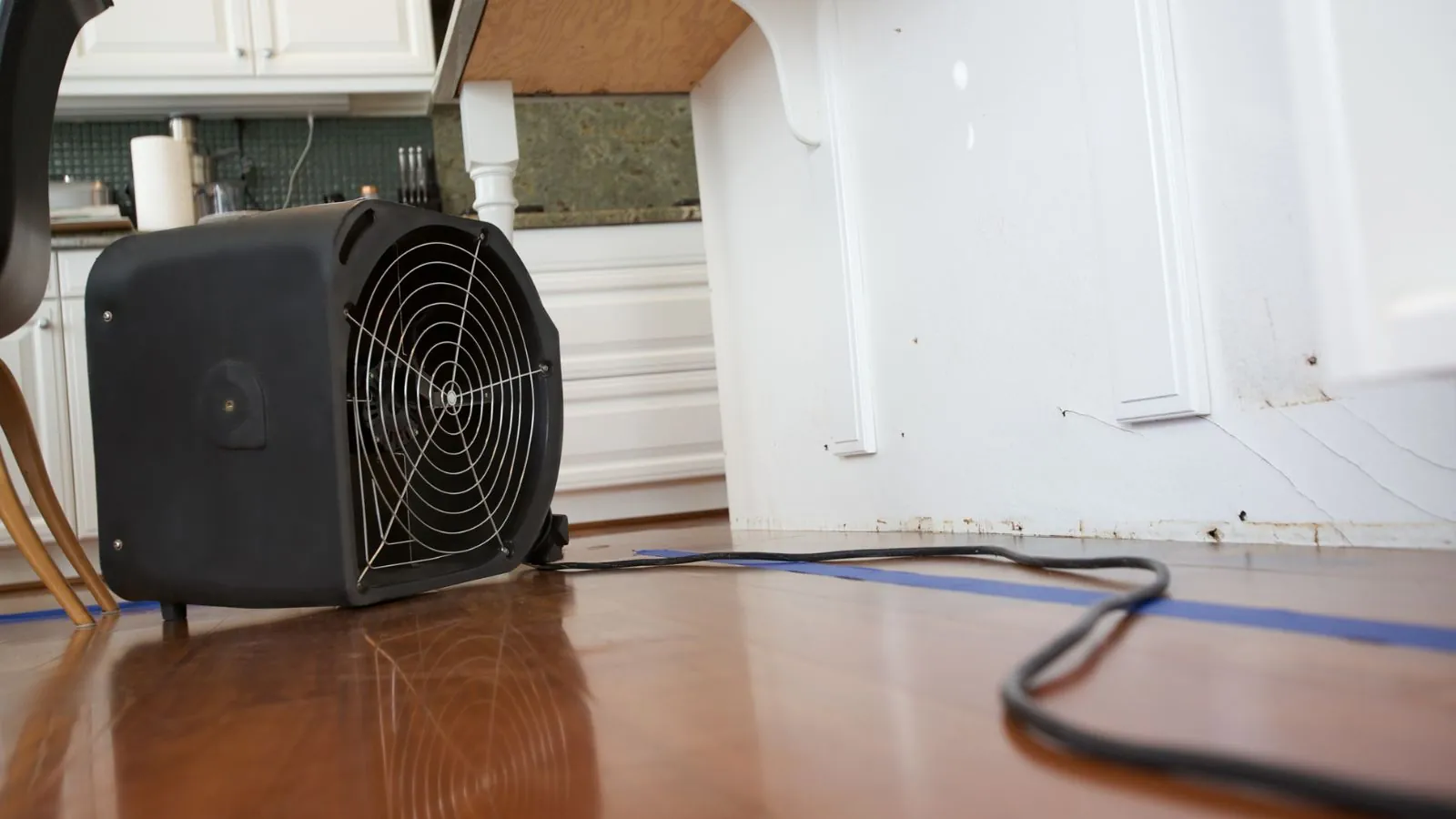
Use fans across the wet area and a dehumidifier in the room.
5Check after 48 hours
Press the area and look for odors or color changes.
How to tell when it is dry
Surface dry is not structurally dry. Feel baseboards, carpet edges and the bottom of walls. A cheap moisture meter helps, but it is not as sensitive as a professional meter.
If a spot still feels cool, damp or smells musty after a couple of days, there is probably more water than you can see.
Where DIY drying goes wrong
Many people dry the surface and leave water in the layers beneath. Carpet may feel dry while the pad holds water. A floor may look fine while the subfloor stays wet. Hidden moisture can lead to warped boards and mold.
Our structural drying page explains how pros dry layers you cannot reach.
Electrical safety first
Never use a wet vacuum or fan if the cord or outlet is near standing water. If water reached an outlet or the panel, stay out and call the utility or an electrician. Do not touch appliances while standing in water.
When in doubt, shut off power to the area from a dry breaker box, or leave it off until a professional checks it.
Why speed matters
Materials left wet for a day or two begin to swell, stain or grow mold. The sooner the area is dry, the less to replace. If you cannot dry it within about 48 hours, call a professional.
You can call us at (508) 286-8971 24/7 and we explain what to expect. The line is open at night too.
Do not rent heavy equipment blindly
Rental dehumidifiers and air movers can help on small jobs, but wrong placement or wrong settings can waste time. We do not offer equipment rentals. If you choose to rent, follow the instructions closely and check readings.
For a wet wall, a flooded floor or a basement, professional equipment and measured drying are a better route.
A room-by-room guide
In a bathroom, wipe the floor, run the fan and leave the door open. In a kitchen, dry under the sink and open cabinet doors. In a laundry room, check behind the machine and wipe the floor under it.
In a basement, only handle a small spill on a bare floor. Anything that reached drywall, carpet or stored boxes is usually a bigger job than it looks.
Tools that help and tools that do not
Towels, a mop, a wet vacuum, box fans and a dehumidifier cover most small spills. A moisture meter is a useful extra. Heaters and hair dryers on high heat do more harm than good, since they can dry the surface and leave moisture deeper.
Do not run fans if they would blow contaminated water or dust around the room. Clean water only.
When a spill is not really a spill
A wet patch that comes back after you dry it means the source is still active. A slow leak, a condensation problem or groundwater will keep wetting the area. Treat repeated damp spots as a signal to find the source.
The crawl space water damage and basement water damage pages explain two common hidden-moisture cases.
A simple checklist before you call it done
Check that the surface is dry to the touch, no musty smell remains, and a tissue pressed against the area does not feel cool or damp. Check again the next day and after three days. If anything feels damp, keep drying or call for help.
Keep the fans and dehumidifier running longer than you think you need. Over-drying a small area costs little.
Special cases: fabrics, books and furniture
Washable fabrics from a clean spill can go in the machine. Books and papers dry best standing up with pages fanned. Wood furniture can be wiped and set on blocks so air reaches the legs.
Leave upholstered pieces in open air with fans on them, and check for odors after a day. Soaked foam does not dry quickly.
Why hidden moisture needs a meter
The ANSI/IICRC S500 standard for water damage restoration makes the point that hidden moisture needs measuring, not guessing.
That is the reason small spills are safe to handle and wall or floor moisture is not.
Dartmouth humidity and drying time
Dartmouth has a coastal climate with damp summers, and air that already carries moisture slows drying. In humid months, a dehumidifier does more than fans.
About 45 percent of southeastern Massachusetts homes were built before 1960, per SRPEDD. Older homes often have plaster, wood subfloors and basements that dry slowly.
The master plan lists flood-prone places such as Eddy Street and Old Fall River Road. If water came from outside, treat it as contaminated and do not handle it yourself.
Nearby towns
The same guidance applies across the region. See water damage restoration in New Bedford and water damage restoration in Mattapoisett for notes on nearby housing.
When in doubt, call.
Questions Dartmouth homeowners ask
On a small area, with caution, but fans and a dehumidifier are more effective and safer.
Growth can begin after a day or two of damp conditions. Drying quickly lowers the risk.
Clean-water spills caught fast can be dried. Contaminated water means removal.
Yes, they move air across surfaces, but they do not remove moisture from the room.
In dry weather, yes. In humid weather, a dehumidifier works better.
Stains, bubbling paint, a musty smell or a meter reading show it.
Water still spreading?
Not sure it is dry? Call the 24/7 line. We measure moisture and explain what to do next.